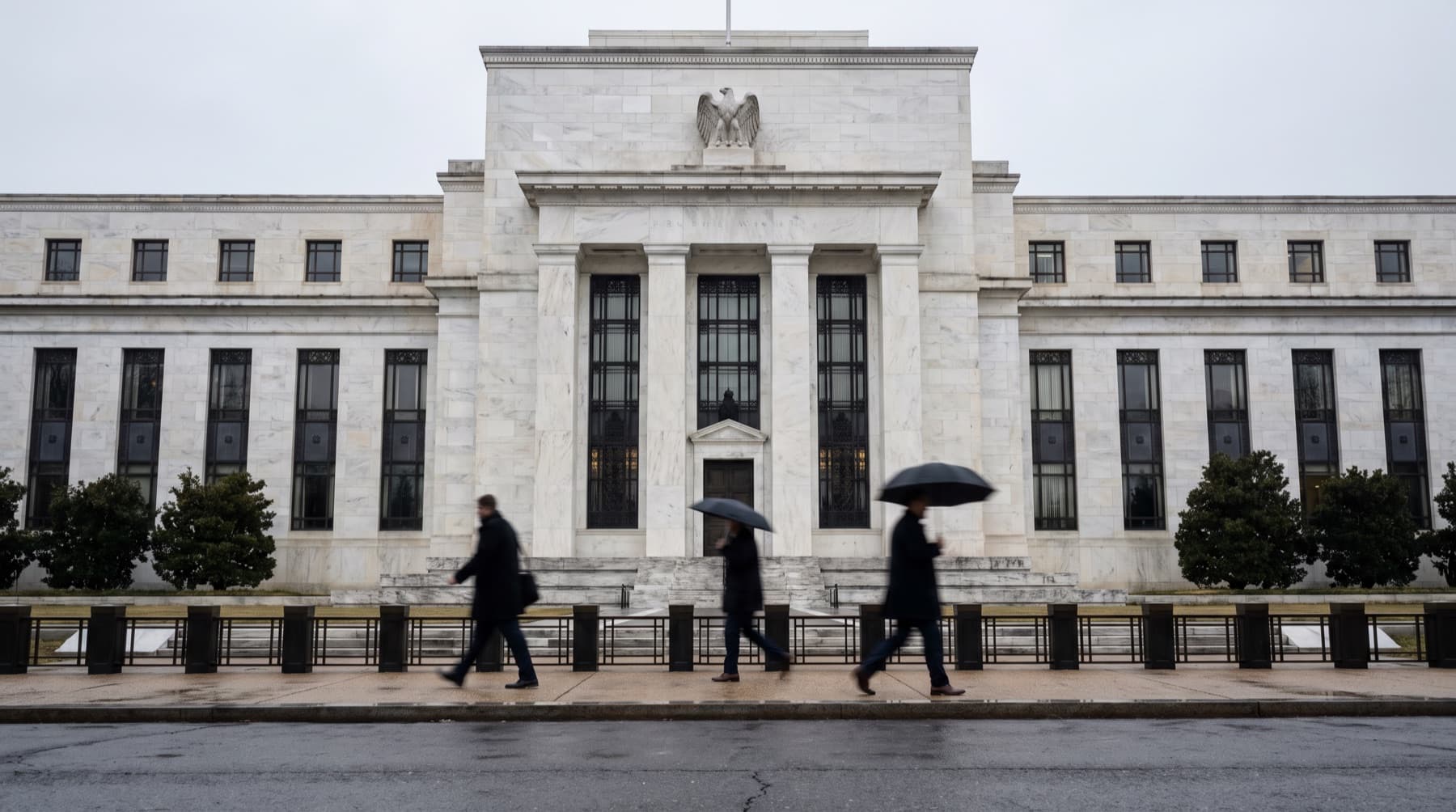
Washington —The federal funds rate is the interest rate banks charge one another to borrow reserves overnight, and it is the Federal Reserve’s main lever over the economy. The Fed does not set it directly; its policy committee sets a target range, 3.75 to 4 percent since September 2026, and uses a handful of administered rates to keep overnight trading inside that range.
The rate matters well beyond the interbank market. The Fed describes the chain plainly: changes in the target range influence other short-term interest rates, which in turn affect the spending decisions of households and businesses, and through them economic activity, employment and inflation. When people search for a Fed rate cut or a Fed rate hike, this is the rate they mean.
How does the Fed set the federal funds rate?
Decisions belong to the Federal Open Market Committee, or FOMC, made up of the members of the Fed’s Board of Governors in Washington and presidents of the regional Federal Reserve Banks. The committee holds eight regularly scheduled meetings a year, plus others as needed, and announces its decision at 2 p.m. Eastern Time on the second day of each meeting. Four of the eight meetings come with a Summary of Economic Projections, which includes officials’ own expectations for the rate.
The committee’s goal is set by law as a dual mandate, which the Fed refers to in every statement: maximum employment and stable prices, with inflation defined as a 2 percent goal. Moves are usually made in steps of 25 basis points, a quarter of a percentage point, though larger steps are used when conditions demand. In 2022 the Fed raised the range in 75-basis-point increments four times in a row, and in March 2020 it cut by 100 basis points at once.
Because the federal funds rate is a market rate, the Fed steers it rather than fixing it. According to the Fed, it does this primarily by changing the interest it pays banks on reserve balances and the rate on its overnight reverse repurchase facility. After the October 2026 meeting, the main settings were:
- Target range for the federal funds rate: 3.75 to 4 percent.
- Interest rate paid on reserve balances: 3.90 percent.
- Overnight reverse repurchase agreement offering rate: 3.75 percent, which acts as a floor for money-market rates.
- Standing overnight repurchase agreement rate: 4.0 percent, which helps cap rates at the top of the range.
- Primary credit rate, often called the discount rate: 4.0 percent.
Why does the federal funds rate matter for borrowers and savers?
The overnight rate feeds most directly into short-term borrowing and saving. Rates on Treasury bills, money-market funds, savings accounts and variable-rate credit such as credit cards and home-equity lines tend to move closely with the Fed’s range. The 13-week Treasury bill yield fell from about 3.79 percent in early November 2025 to near 3.5 percent after the Fed’s December 2025 cut, then climbed above 4 percent as the Fed turned to tightening in September 2026.
Treasury bill yields rose as the Fed turned toward tighter policy
US 13-week Treasury bill yield, sampled roughly every two weeks
Source: Market data, US 13-week Treasury bill yield
Longer-term borrowing costs, including fixed-rate mortgages, respond less mechanically. They track longer Treasury yields, which reflect where investors expect the federal funds rate to go over many years as well as inflation risk. Even so, the direction of Fed policy shows up quickly. The average 30-year fixed mortgage rate rose from 6.00 percent in early March 2026 to a peak of 7.40 percent in October, and stood at 7.18 percent in the week of November 5, according to weekly data in the St. Louis Fed’s FRED database. The 10-year Treasury yield ended trading on November 5 at about 4.84 percent.
For businesses, the rate shapes the cost of bank credit and corporate debt; for investors, it sets the return on cash against which stocks and bonds are judged. That is why a single Fed decision can move currencies, equities and bond markets within minutes of the 2 p.m. announcement.
Where is the federal funds rate now?
This section reflects data available as of November 6, 2026, and will date faster than the rest of this page.
The FOMC held the target range at 3.75 to 4 percent at its October 27-28, 2026 meeting, on a 10-2 vote. The two dissenters, Governor Lisa D. Cook and Cleveland Fed President Beth M. Hammack, preferred to raise the range by a quarter point. The hold followed a 25-basis-point increase at the September 2026 meeting, the Fed’s first hike since July 2023. That increase reversed the last of three quarter-point cuts made between September and December 2025, which had taken the range to 3.50 to 3.75 percent.
“Inflation remains elevated. The accumulation of more information will help the Committee determine the policy stance appropriate to ensure a timely return of inflation to the Committee’s 2 percent goal.”
The effective federal funds rate, the rate actually paid in overnight trading, has held at 3.88 percent since at least late September, comfortably inside the range. Inflation explains the Fed’s posture: consumer prices rose 4.0 percent in the 12 months to September 2026, according to Bureau of Labor Statistics data, up from 2.7 percent in February. Unemployment was 4.2 percent in September, little changed over the year. Hammack said on November 5 that the committee may need to tighten policy gradually to bring inflation down, according to Yahoo Finance.
When is the next Fed rate decision, and how are rate cut odds measured?
The next scheduled FOMC meeting is December 8-9, 2026, and it will include updated economic projections. The Fed’s tentative 2027 calendar has meetings on January 26-27, March 16-17, April 27-28, June 8-9, July 27-28, September 14-15, October 26-27 and December 7-8. Minutes of each meeting are released three weeks after the decision, and often shift expectations as much as the statement itself.
Published Fed rate cut odds are not forecasts by the central bank. They are probabilities inferred from prices of fed funds futures and related contracts, which let traders bet on the average effective rate in a given month. They change daily with economic data and Fed officials’ remarks, and can swing sharply around the monthly jobs report and consumer price index.
Treasury yields offer a simpler read. On November 4 the 2-year Treasury yield was 4.58 percent, about 70 basis points above the effective federal funds rate. A 2-year yield well above the policy rate is usually consistent with investors expecting the Fed to hold rates higher or raise them, rather than cut, over the next two years. As of early November 2026, with the last move a hike and two officials voting for another, the debate inside the Fed was about whether to tighten further, not when to ease.
What would change that are the inputs the committee names in its own statements: the path of inflation relative to the 2 percent goal, the strength of the labor market, and the pace of economic activity. Readers tracking the next Fed rate move should watch the monthly jobs and inflation releases, the December projections, and the minutes of the October meeting.